Hello there,
Welcome back to K&T blog, how was your week?
Officially half of the year is gone, we hope you are looking back with a smile because of the weight loss and fitness progress you have made so far in this year. On our side, this week we were recovering from a bout of flu that we suffered the previous week, so not much training was done, and a lot of cheating and deviations from our set menu took place. However, It was good to realise that our efforts towards living fit and healthy yields numerous rewards, in this case it was the quick recovery we experienced as compared to the time before we endeavored on a weight loss journey. Although the symptoms were quite severe, our bodies did not allow us to be bed-ridden and mope around but instead we were very active and focused on our responsibilities. We wondered, was it that our immune systems were now stronger ? or was it that our lifestyle habits were so strong that we continued living as close to normal as possible even in an unfavorable condition ? or maybe it was both? in any case, it was good to realise the change, and we are grateful to be back in good health.
This week we write about the process of losing weight, how does it actually work? When we started our weight loss journey we did not think much about how weight loss actually works other than knowing that we had to train and try to eat healthy. This approach is simple and it is probably the best way to approach weight loss because of its simplicity, we cant reiterate enough that simplicity is better for weight loss. But looking back we think it could have benefited us more had we tried to understand on a high level how our bodies work when it comes to losing/gaining weight, we would have probably avoided a lot of mistakes and saved ourselves from lots of hurtful feelings, the scale can hurt hey 🙂 .
So how does weight loss work? In it’s simplest form, weight loss happens when we use more energy than we put in the body. We eat food for energy, when this energy is depleted before the body is finished with its tasks, the body retrieves energy from the fat in our body, then we start to lose weight. Repeating this daily over a sustained period of time results in visible weight loss. Therefore ENERGY IN should be less than ENERGY OUT. Below is a flowchart we created to showcase this process in a simplified way, it is probably oversimplified as there are more nuances to this process, but hey we think it gets the job done.
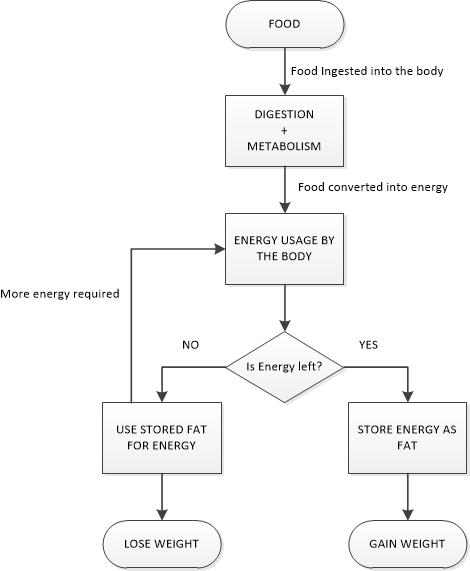
A practical example of this process is by comparing food with money, contrary to what we are accustomed to with regards to money, that we need to spend less and save more, for weight loss however, when we use money as an example, we have to spend more and not save at all, in this way we get to use and deplete our savings account(Fat storage).The more money(energy) we get in a day the more we need to spend before the day end ,otherwise the money that is left get stored in our savings account (Fat storage). But when we get less money in a day, we spend it and require more, we then get to withdraw from our savings account (Fat storage) to supplement the deficit.
The danger of this simplified process is that it can be interpreted as that one needs to starve themselves in order to lose weight. This is very contrary to the reality of weight loss, you don’t have to be starved to lose weight, you need to eat real food, satiating food . The key to avoiding starvation is to eat whole natural foods and to limit/avoid highly processed foods. To clarify this, we will continue with the example of money, the currencies of money are different ,some currencies are superior than others, some currencies can achieve more with less whilst others can achieve less with more. With whole foods, you can achieve more whilst eating less, with processed food on the other hand, you achieve less with eating more, way more.
The currency of food is calories, but not all calories are created equal, the calories of whole foods are superior than the calories of processed foods(e.g what you get from 100 calories of potatoes is different from 100 calories of potato chips) . Whole natural foods are a good currency and processed foods are a bad currency, for weight loss (and for good health in general) choosing a good currency is a win. With good currency (whole foods) the body is able to use it efficiently and it is easy to trade as there are nutrients acceptable to the body, whilst with bad currency (processed foods) the body struggles to use it efficiently and it is hard to trade with as there are toxins and chemicals alien to the body.
That’s it for this week, understanding the basic process of losing weight gives you the edge on your weight loss efforts, it empowers you to make the right food choices and lifestyle activities. It helps you understand why certain foods and lifestyle habits tips the scale for you or against you. To sum-up the process of losing weight we can simply say:
(1) You lose weight by eating healthy foods, these are whole natural foods.
(2) And by expending more energy than you usually do, that is moving a little bit more.
PS: If you are struggling with identifying whole natural foods, someone said “If you cant grow them or make them at home, then it might not be food” ,maybe this is a good way to distinguish whole natural foods from those that are highly processed. 🙂
Until next week, stay blessed and make the best of the second half of the year.
Kat & Tshepi

